Wildlife encounters don’t start with danger
Most wildlife encounters don’t begin with aggression.
They begin with surprise.
You notice movement in the distance. A sound you weren’t expecting. An animal crossing your path and stopping just long enough for both of you to register each other.
For a moment, everything feels still.
This is where beginners often misunderstand what “wildlife safety” really means.
Movies, headlines, and online advice tend to jump straight to deterrence — what to carry, what to use, how to scare something away. But in real life, those moments come much later, and often not at all.
Most situations resolve themselves long before deterrence is needed.
The deciding factor is almost always awareness.
Awareness of where you are. Awareness of what the animal is doing. Awareness of how your own behaviour is affecting the moment. When people miss those signals, encounters feel sudden and threatening. When they notice them early, encounters are usually brief, calm, and uneventful.
This article isn’t about turning you into a wildlife expert.
It’s about helping you recognise the early cues that matter — the ones that let you slow down, create space, and avoid escalation without panic or bravado.
You’ll see three real-life scenarios. Each one reflects how wildlife encounters actually unfold for everyday people: hikers, campers, families, and casual outdoor explorers. No dramatic confrontations. No heroic actions. Just ordinary moments where the outcome depends on how early you notice what’s happening.
We’ll focus on actions first, judgment second, and deterrence only as a last consideration.
Because when it comes to wildlife encounters, the safest outcome usually isn’t about doing more.
It’s about noticing sooner.
Scenario 1: You notice something moving before you see what it is
The moment your attention shifts
You’re walking along at an easy pace. Conversation is light, or maybe you’re alone with your thoughts. The environment feels familiar enough that your attention is relaxed rather than focused.
Then something changes.
Not a sound you can name yet. Not a clear shape. Just movement where there wasn’t any before.
Your eyes lift. Your body slows slightly without you consciously deciding to stop. For a brief moment, you’re not sure whether what you noticed even matters.
This is how most wildlife encounters actually begin.
Not with a sudden appearance, but with a subtle cue that something nearby is active.
The difference between early awareness and surprise
Beginners often think wildlife encounters are defined by proximity — how close the animal is when you notice it.
In reality, they’re defined by timing.
When you notice movement early, your nervous system stays relatively calm. You have time to process what you’re seeing. Distance still exists. Options still exist.
When you notice late, everything compresses. Distance feels shorter. Decisions feel urgent. Your body reacts before your brain has fully caught up.
The animal hasn’t changed.
The timing has.
What awareness actually looks like in real life
Awareness in outdoor settings isn’t about being on edge or scanning constantly.
It’s about letting your attention widen just enough to notice patterns.
Movement against stillness. Sound that doesn’t match the background. A pause in bird noise. A rustle that repeats instead of fading.
In this scenario, you’re far enough away that the animal hasn’t reacted to you yet. That’s important.
Animals usually notice humans before humans notice them. When that doesn’t happen, it’s often because the human is distracted, moving quickly, or assuming the space is empty.
Early awareness gives you the advantage of time — not control, not dominance, just time.
Why slowing down matters more than stepping back
A common beginner instinct is to stop abruptly or step backward.
Sometimes that’s appropriate. Often, it isn’t necessary.
Sudden changes in movement can draw attention or trigger curiosity. Slowing your pace, softening your posture, and giving the animal time to register you as non-threatening usually leads to the simplest outcome.
Most animals aren’t looking for confrontation. They’re assessing.
When you move calmly and predictably, you give them information they can use to disengage.
This is where awareness quietly prevents escalation.
Reading behaviour without interpreting intent
Beginners often try to interpret intent too quickly.
“Is it aggressive?” “Is it stalking?” “Should I scare it off?”
Those questions come later, if at all.
At this stage, the more useful observations are simple:
- Is the animal moving toward you, away from you, or across your path?
- Has it noticed you yet?
- Is its movement steady, cautious, or erratic?
You’re not trying to diagnose behaviour. You’re just gathering information.
That information determines whether the encounter stays uneventful.
Creating space without creating tension
In many cases, the safest action is also the least dramatic.
You slow. You pause. You allow distance to remain distance.
Sometimes that means waiting quietly while an animal crosses your path. Sometimes it means adjusting your route slightly without making a point of it.
These actions don’t look like “doing something,” but they are.
You’re choosing not to compress the moment.
You’re letting awareness do the work that deterrence never needs to.
How this applies beyond wildlife encounters
This pattern — noticing early, slowing down, observing before acting — shows up across many safety situations.
It’s the same mindset that helps people avoid unnecessary escalation in crowded public spaces, unfamiliar environments, or moments of uncertainty.
We explore this awareness-first approach more broadly in situational awareness habits in public spaces, because the principle is the same whether the trigger is human or animal.
In wildlife encounters, this awareness often means the encounter ends before it really begins.
You notice movement. You slow down. The animal moves on.
No fear. No tools. No confrontation.
Just an ordinary moment handled early enough that it never becomes anything more.
Scenario 2: The animal is aware of you — and stops moving
When the encounter pauses instead of passing
You’ve noticed the animal early enough that nothing feels rushed.
You slow down. You stay where you are.
But this time, the animal doesn’t continue on its way.
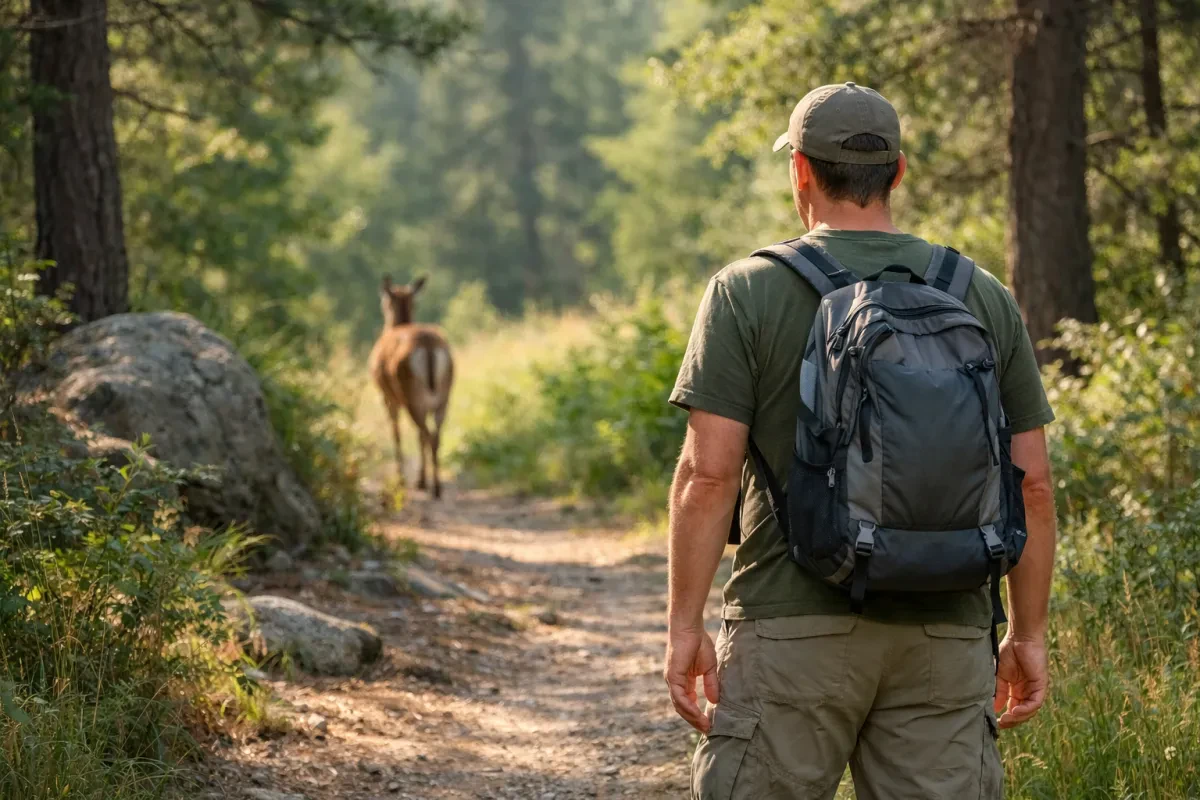
It stops.
Not charging. Not retreating. Just holding position long enough for you to realise that it’s aware of you now.
This is the point where beginners often feel a sudden spike of uncertainty.
The encounter hasn’t escalated — but it hasn’t resolved itself either. And that pause can feel uncomfortable.
This is where awareness matters more than confidence.
Why stillness can feel more threatening than movement
When an animal keeps moving, the situation feels predictable.
When it stops, people often fill the silence with assumptions.
Is it deciding what to do? Is it assessing me? Is this about to turn into something else?
In reality, that pause is usually information-gathering — on both sides.
Animals pause to assess distance, behaviour, and intent. Humans pause because their instincts are waiting for a clear signal.
Neither side is committed to an outcome yet.
And that’s a good thing.
What awareness looks like when distance still exists
At this stage, the most important factor is space.
Distance gives you time. Time keeps decisions calm.
You don’t need to make the animal move. You don’t need to “do” anything yet.
What matters is how you hold the moment.
Stable footing. Predictable posture. No sudden movements.
When people tense up, they often change their body language without realising it — leaning forward, stiffening their arms, shifting weight quickly.
Those small changes can be more noticeable to animals than people expect.
Remaining still, relaxed, and upright communicates something very simple:
You’re not approaching. You’re not chasing. You’re not a problem.
The mistake of trying to “assert control” too early
Some advice encourages people to take action immediately in these moments.
Make noise. Wave arms. Move forward. Show dominance.
That advice skips a critical step.
It assumes escalation is already required.
In many beginner encounters, it isn’t.
Trying to force an outcome when distance still exists can actually remove the animal’s easiest option: disengagement.
When you rush to deter, you shorten the moment instead of letting it resolve naturally.
Awareness-first behaviour keeps options open 🌿
Letting the animal choose the exit
In most cases, animals don’t want to share space.
They want a clear path away.
Your job isn’t to scare them off — it’s to avoid blocking that path.
That might mean waiting quietly for a few seconds. It might mean stepping slightly to the side rather than straight back. It might mean taking a slow step away once the animal shifts its attention elsewhere.
These movements aren’t dramatic.
They’re subtle, deliberate, and unthreatening.
When animals feel they can leave without pressure, they usually do.
Managing your own internal response
This is also the moment where your internal state matters.
Even if you’re calm on the outside, your thoughts may be racing.
That’s normal.
The goal isn’t to suppress fear — it’s to prevent it from driving your behaviour.
Slowing your breathing. Grounding your feet. Giving yourself permission to wait instead of act.
These small internal adjustments help keep your movements measured rather than reactive.
The same approach is useful in many unexpected situations where uncertainty spikes. We explore that internal response more deeply in how to prepare for emergencies without panic.
When awareness does the work for you
Most encounters at this stage end quietly.
The animal looks. You wait.
Then it turns and moves off, choosing distance over engagement 🦌
No deterrence was required.
No confrontation occurred.
Just two beings noticing each other early enough that neither felt cornered.
This is why awareness comes before deterrence.
Not because deterrence never works — but because, in many real-world encounters, you never need to get there.
Scenario 3: The distance closes faster than you expected
When awareness becomes urgency
Most wildlife encounters never reach this stage.
But sometimes, despite early awareness and calm behaviour, distance changes faster than you’d like.
An animal shifts direction instead of moving away. Terrain limits your options. Visibility is shorter than you realised. What felt comfortably spaced a moment ago suddenly feels close.
This is the point where beginners often believe deterrence is inevitable.
It isn’t always — but this is where judgment matters most.
Why escalation feels sudden even when it isn’t
Encounters that feel abrupt usually aren’t truly sudden.
They’re the result of compressed space, limited escape routes, or environmental factors you couldn’t fully control — dense vegetation, blind corners, wind direction, or uneven ground.
The animal hasn’t necessarily become aggressive.
The margin has simply narrowed.
This is where people confuse urgency with panic.
Urgency means you need to act deliberately. Panic means acting without assessment.
The difference between the two determines how safely the moment resolves.
What still matters when distance is reduced
Even now, awareness is doing more work than deterrence.
You’re noticing posture, movement, and direction rather than reacting emotionally.
Is the animal advancing, or adjusting position? Is it focused on you, or scanning the environment? Is it reacting to you, or to something else nearby?
These observations shape your response.
At closer distances, sudden movement becomes more significant — both for you and for the animal.
Staying upright, visible, and predictable helps prevent misinterpretation.
This is not about “standing your ground.”
It’s about remaining legible.
When deterrence becomes a consideration — not a reflex
Deterrence belongs here, not earlier.
Only when distance is limited, disengagement isn’t happening on its own, and space cannot be easily restored.
Even then, deterrence is a tool — not a solution.
Its purpose is to create space, not to dominate or punish.
Effective deterrence is brief, proportionate, and stops as soon as distance returns.
Overuse or escalation can remove the animal’s safest option: retreat.
That’s why many wildlife authorities emphasise awareness, avoidance, and de-escalation long before deterrence is needed. The National Park Service consistently advises visitors that most wildlife incidents occur when people move too close or react too aggressively, rather than when animals initiate contact. Source.
Managing your own response under pressure
This is the hardest part for beginners.
Your body is ready to react before your mind finishes evaluating.
Heart rate rises. Muscles tense. Thoughts speed up.
That doesn’t mean you’ve lost control.
It means you need to slow the moment down internally, even if externally it feels fast.
Grounding yourself — feeling your feet, steadying your breathing, keeping movements intentional — helps prevent overreaction.
This internal control often determines whether deterrence is effective or escalatory.
Creating an exit instead of forcing one
Whenever possible, your goal remains the same:
Create space. Allow disengagement. Let the encounter end.
Sometimes that means backing away slowly. Sometimes it means stepping aside to open a path. Sometimes it means holding position briefly instead of pushing movement.
These decisions aren’t dramatic.
They’re situational.
And they’re guided by awareness, not fear.
Why this scenario doesn’t define the whole experience
Beginners often fixate on this stage when thinking about wildlife safety.
But it’s important to remember:
This is the exception, not the norm.
Most encounters end well before deterrence is necessary because awareness prevents distance from collapsing in the first place.
When it doesn’t, calm, proportionate responses still resolve most situations without harm — to you or the animal 🐾
This is why the principle holds across all three scenarios.
Awareness comes first. Deterrence comes last.
And in most real-world wildlife encounters, awareness alone is enough.
Why awareness is usually enough
When people think about wildlife encounters, they often imagine the rarest moments first.
The close call. The confrontation. The story that gets retold later.
But most real encounters never reach that point.
They unfold quietly, shaped by what you notice early and how you respond before urgency sets in.
Across all three scenarios, the pattern is consistent.
Awareness creates time. Time creates options. Options prevent escalation.
Deterrence has its place, but it’s not the foundation of safety. It’s a backup — something you hope you never need because the situation resolved itself earlier.
For beginners, this is an important shift in thinking.
Wildlife safety isn’t about being prepared to act aggressively.
It’s about being prepared to notice, pause, and choose restraint when restraint is still possible.
That mindset doesn’t just reduce risk. It changes how encounters feel.
Instead of fear, there’s clarity. Instead of urgency, there’s space. Instead of confrontation, there’s separation.
As Just In Case Gear continues to build guidance around preparedness, this principle shows up again and again.
The safest outcomes usually come from doing less — earlier.
When awareness leads, most wildlife encounters end the same way:
You notice each other. You give space. You both move on.
And the outdoors remains what it was meant to be in the first place — a place you can enjoy with confidence, respect, and calm judgment 🙂
Frequently asked questions about wildlife encounters
Are most wildlife encounters dangerous?
No. Most wildlife encounters are brief and uneventful. Animals usually avoid humans when they notice each other early and have space to disengage.
Should I always try to scare wildlife away?
No. Deterrence is rarely the first or best response. In many situations, staying calm, slowing down, and allowing distance is safer and more effective.
What’s the most important skill for wildlife safety?
Awareness. Noticing movement, behaviour changes, and environmental cues early gives you time to respond calmly and avoid escalation.
When is deterrence actually appropriate?
Deterrence may be appropriate when distance has closed, the animal is not disengaging, and space cannot be easily restored. Even then, it should be brief and proportional.
Do wildlife encounters usually escalate?
No. Most encounters resolve without incident when people remain calm, predictable, and give animals space to move away.
Can these principles apply outside wildlife situations?
Yes. The awareness-first approach applies to many safety situations, including crowded spaces, unfamiliar environments, and moments of uncertainty.