👀 Situational Awareness Habits in Public Spaces
Situational awareness has a branding problem.
Most people hear the phrase and imagine someone hyper-alert, scanning everyone, expecting trouble, living with their nervous system permanently switched on. That isn’t awareness — that’s tension. And it’s not sustainable.
Real situational awareness is calmer than that.
It’s not fear. It’s not paranoia. It’s a set of small habits that keep you oriented in public spaces — so you’re less likely to drift into autopilot, and more likely to notice early when something doesn’t feel right.
Preparedness in public spaces isn’t about “winning a fight.” It’s about reducing the chance you end up in one. It’s about choosing simplicity over stress. Clarity over guessing. Options over panic.
🧠 Why awareness disappears when you need it most
Most people lose awareness for one reason:
cognitive load.
When your brain is juggling tasks — kids, shopping, directions, work messages, health worries, time pressure — it starts saving energy by defaulting to autopilot. You still function, but your attention narrows. You miss subtle details. You react later than you want to.
And when something unexpected happens, panic doesn’t show up because you’re weak. It shows up because you’re forced into fast decisions without a clear next step.
✅ The goal: stay oriented without becoming anxious — so your next step is easier to find.
Below are three realistic public-space scenarios where people commonly drift into autopilot — and how simple awareness habits (plus the right “earned” tools) change the emotional temperature of the moment.
New to calm preparedness? Start here first: How to Prepare for Emergencies Without Panic — it’s the foundation that makes the habits in this article easier to stick to.
🅿️ Scenario 1: The Car Park Walk (The Autopilot Trap)
Micro-moment 1 — The transition
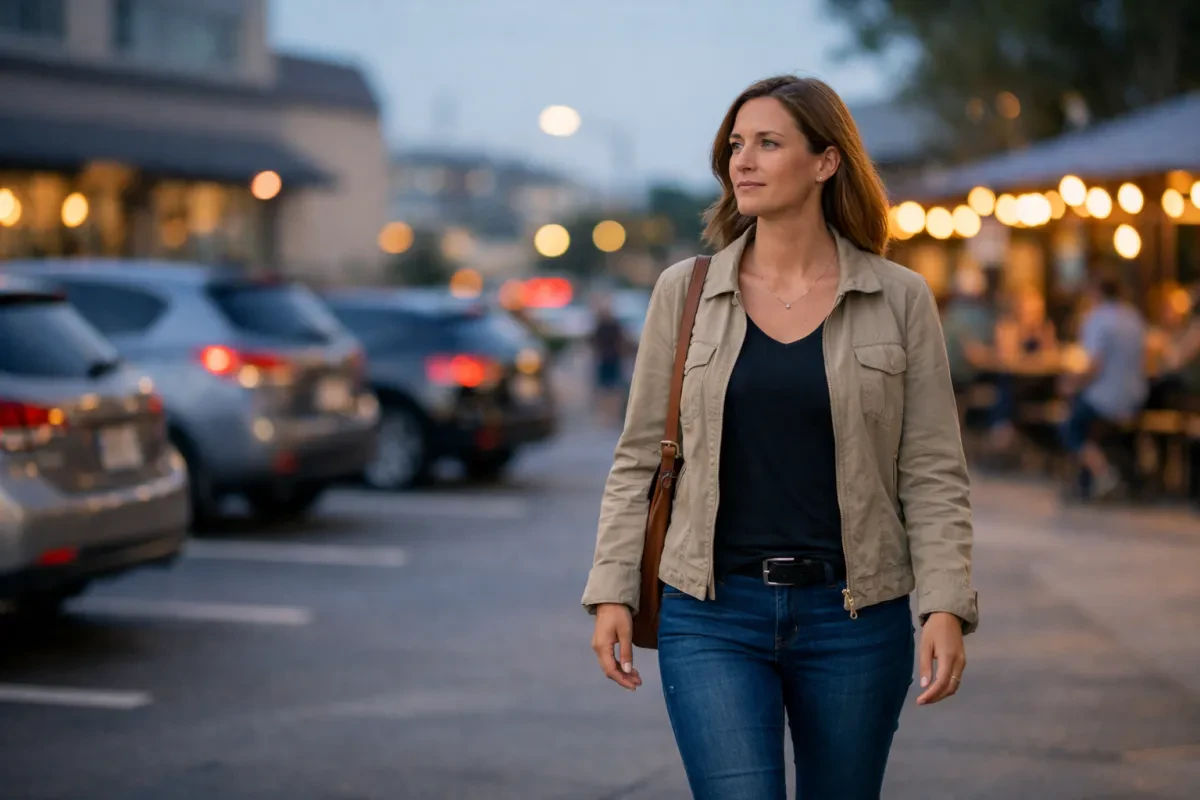
You leave the shop and step into the car park. It’s a transition zone — not quite “inside”, not quite “home”. That’s why people switch off here.
Your hands are full. Your mind is already ahead: dinner, traffic, the next stop, what you forgot, what you’re late for.
You unlock the phone without thinking. You glance at a message. You reply quickly. You keep walking.
Nothing feels dangerous. That’s the point.
But if something did happen — someone approaching too quickly, someone stepping into your path, a moment that requires immediate orientation — your brain is a half-beat behind because it isn’t fully present in the space.
Micro-moment 2 — The wobble
Here’s what the “wobble” looks like in a car park:
- You can’t quite remember where you parked.
- You slow down, unsure.
- You start looking around more obviously.
- You feel mildly embarrassed and distracted at the same time.
This isn’t a safety issue yet — but it’s a presence issue. Your body language changes. Your pace changes. Your attention splits.
This is where most people feel “off” without knowing why. The environment didn’t change — their orientation did.
Micro-moment 3 — The awareness habit
A simple habit resets everything:
Before you step into the car park, take five seconds to come back online.
Not scanning. Not searching for threats. Just re-orienting.
- Phone away.
- Head up.
- Hands free (as much as possible).
- Eyes forward to your destination.
You’re not becoming “tactical.” You’re becoming available — available to notice, available to adjust, available to act early instead of late.
Micro-moment 4 — Aftermath reflection
Most people don’t regret being calm in public spaces. They regret being unavailable.
Not “I should have been scared.”
More like:
“I knew something felt off… but I didn’t trust myself until it was obvious.”
✅ What “enough” looks like in a car park
- Your phone stays away during transitions (shop → car, car → shop)
- You can name where you’re heading without hesitation
- Your hands are free enough to move naturally
- You trust “early discomfort” and adjust without needing a reason
The one product that earns its place here: a discreet personal safety alarm.
Not because you expect to use it — but because it supports the habit of staying oriented. It gives you a simple, proportional option if something escalates. No confrontation. No force. Just an immediate way to create attention and space.
When you know you have an “if needed” button, your posture changes. You stop bargaining with your instincts. You move earlier, not later.
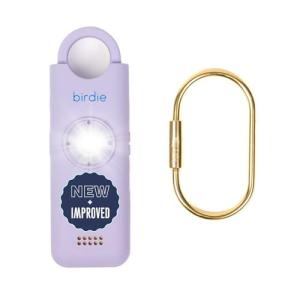
She’s Birdie 3.0 Personal Safety Alarm
A simple, discreet way to create attention and space when something feels off
Product information
$29.95
Product Review Score
4.48 out of 5 stars
33 reviewsProduct links
☕ Scenario 2: Sitting in a Public Place (The Slow Drift)
Micro-moment 1 — Comfort sets the trap
Cafés, food courts, waiting rooms, parks — these are places people treat as “safe enough” and mentally exit.
You sit down. You exhale. You open the phone. Maybe headphones go in. Maybe you reply to messages. Maybe you scroll to switch your brain off for a few minutes.
This is normal.
But there’s a difference between resting and disappearing.
When you fully disappear into your screen, you stop tracking the space around you. You stop noticing who is near you, who is moving, who is lingering. You’re not “unaware” — you’re simply not oriented.
Micro-moment 2 — The wobble
The wobble here often starts as a tiny internal interruption:
You hear footsteps that stop too close.
You sense someone’s presence beside you longer than necessary.
You notice your bag isn’t where you thought it was.
Your brain tries to solve it quietly without making a scene. You glance up. You glance back down. You pretend you didn’t notice. You start replaying the situation internally.
That internal replay is a sign your body is asking for orientation — but your habits don’t support it.
Micro-moment 3 — The awareness habit
A calm situational awareness habit here is simple:
Anchor yourself to the space before you anchor to your screen.
Ten seconds, once.
- Where are the exits?
- Where are the staff / other people?
- Where is your bag and how accessible is it to you (not to someone else)?
- If you had to stand up quickly, would you fumble or flow?
Then you can go back to your phone. The difference is you remain “online” in the background — relaxed, but oriented.
Micro-moment 4 — Aftermath reflection
People don’t usually get hurt because they didn’t have a weapon.
They get hurt because they didn’t have a moment.
A moment to see it early. A moment to move. A moment to decide calmly.
Situational awareness gives you that moment — without requiring you to live in fear.
✅ What “enough” looks like when sitting in public
- You orient once when you arrive (exits, people, flow)
- Your essentials are accessible without rummaging
- You can stand up and leave without collecting “stuff” first
- You don’t fully disappear into your phone for long stretches
The one product that earns its place here: a compact cross-body / sling bag worn in front.
This isn’t about looking tough or “ready for anything.” It’s about reducing friction.
When your keys, phone, wallet, and essentials are in a single front-worn bag, you stop doing the constant pocket-checking dance. You stop placing bags behind you. You stop leaving items on chairs beside you. You stay calmer because you’re not quietly managing micro-anxiety.
Awareness becomes easier because your setup supports it.
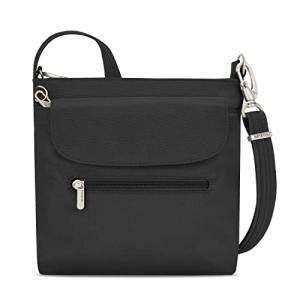
Travelon Anti-Theft Classic Mini Shoulder Bag (Everyday Calm Carry)
A small, organised crossbody that reduces public-space friction—so you stay present, not distracted.
Product information
$38.02 $32.82
Product Review Score
4.44 out of 5 stars
51 reviewsProduct links
🚶 Scenario 3: The “Something Feels Off” Moment (Trusting Yourself Early)
Micro-moment 1 — The feeling arrives before the facts
This is the scenario people struggle to talk about, because it’s not always clear.
You’re walking. Maybe it’s late afternoon. Maybe it’s night. Maybe you’re heading to the car, the train, the shops. You notice someone behind you… then again… then again.
Nothing obvious happens.
But you feel your body shift: shoulders tighten slightly, pace changes, a small surge of alertness.
This isn’t paranoia. It’s pattern recognition.
Your brain has noticed something before your conscious mind has built a story for it.
Micro-moment 2 — The wobble
The wobble here is internal.
You start negotiating with yourself:
- “I’m probably overthinking.”
- “I don’t want to look silly.”
- “Maybe it’s nothing.”
- “What if I’m wrong?”
And because you don’t want to overreact, you do nothing — which makes you feel more powerless — which increases anxiety — which makes your judgement worse.
That spiral is how panic grows.
Not from danger itself. From uncertainty plus hesitation.
Micro-moment 3 — The awareness habit
The habit that breaks the spiral is simple:
Give yourself permission to act on “early off” without needing proof.
Not by confronting someone. Not by escalating.
By creating space and clarity:
- Change direction.
- Step into light.
- Move toward other people.
- Make it harder for someone to stay close without being obvious.
You’re not accusing anyone.
You’re choosing your own positioning — and that is always allowed.
Micro-moment 4 — Aftermath reflection
Most people who’ve had a close call say the same thing afterward:
“I knew earlier… I just didn’t want to believe it.”
Situational awareness doesn’t guarantee nothing happens. But it increases the chance you act while you still have options — when the situation is still small.
✅ What “enough” looks like when something feels off
- You trust early discomfort and adjust position without apology
- You move toward light, people, or staff without overthinking
- You keep your hands and attention available during transitions
- You have one simple tool that supports clarity and space
The one product that earns its place here: a small, simple, pocketable flashlight.
Not a feature-heavy “tactical” torch. Not something complicated. Just a light you can activate instantly.
Light does a few powerful things in uncertain moments:
- It restores orientation (you can actually see what’s around you).
- It changes your posture (you look more present).
- It makes it harder for someone to stay hidden or ambiguous.
- It gives your brain certainty — and certainty reduces panic.
Even if nothing happens, the light helps you feel grounded instead of small.
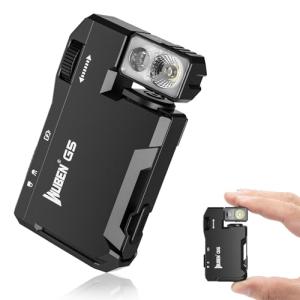
WUBEN G5 Rechargeable EDC Flashlight
A compact everyday light designed to restore clarity and awareness when visibility drops.
Product information
$26.65 $19.99
Product Review Score
4.45 out of 5 stars
172 reviewsProduct links
🧘 Situational Awareness Without Anxiety
Situational awareness isn’t a personality trait. It’s a practice.
It’s not about expecting bad things. It’s about respecting that public spaces are unpredictable — and choosing habits that keep you calm, oriented, and able to respond.
You don’t need to live on edge.
You just need fewer moments where you realise you’ve been on autopilot for too long.
Final thought: Awareness isn’t intensity. It’s orientation. And orientation is one of the most underrated forms of personal safety.
Being aware of your surroundings and the activities going on around you can help you avoid potential dangers and improve your reaction time without fear. A police department’s situational awareness and personal safety tips explain how simple habits — keeping your senses present and minimizing distractions — make everyday life clearer and safer.
❓ Frequently asked questions
Is situational awareness the same as being paranoid?
No. Paranoia is fear-driven and exhausting. Situational awareness is calm orientation — noticing what’s normal so you can spot what isn’t.
What’s the simplest situational awareness habit I can start with?
Transitions. Phone away when moving between “inside” and “outside” spaces (shops → car, car → home, station → street).
Should I always avoid using my phone in public?
No. The goal isn’t restriction — it’s timing. Use it when you’re settled. Minimise it when you’re moving or navigating uncertain spaces.
What does “trust your gut” actually mean?
It means you allow yourself to adjust your position early — change direction, move into light, step closer to people — without needing a courtroom level of evidence.
How do I stay aware without staring at people or looking intense?
Awareness is mostly posture and orientation: head up, eyes forward, gentle scanning, knowing exits. You don’t need to fixate on anyone.
What if I feel embarrassed acting on a weird feeling?
That embarrassment is common — and it’s often what keeps people stuck. Reframe it: you’re not accusing anyone; you’re choosing your own positioning.
Are personal safety alarms actually useful?
Yes, because they are simple and proportional. They create attention and space without confrontation. They support early action when your body says “move.”
Why is a flashlight helpful if I already have a phone light?
Phone lights are often slower, fiddlier, and cost you battery. A small flashlight is immediate and predictable — which matters most when you’re uncertain.
What’s “enough” for everyday public safety?
Enough is when you feel calmer because you have habits and options: oriented transitions, basic positioning, and one or two simple tools that reduce friction.