There’s a specific kind of quiet that settles in when your car stops working at night.
It’s not dramatic. There’s no crash, no sudden chaos. Just the soft click of the engine turning over and not quite catching. Maybe the dashboard lights glow a little longer than they should. Maybe the engine just… stops. You pull over where you can, switch on the hazard lights, and sit there for a moment with your hands still on the wheel.
During the day, a roadside breakdown is mostly an inconvenience. At night, it feels different — not because something bad is about to happen, but because your surroundings change faster than your situation does. Traffic thins out. Shops are closed. You can’t easily read what’s around you. And time seems to stretch in unfamiliar ways.
For most people, this isn’t about danger. It’s about uncertainty.
You don’t know how long help will take. You’re not sure who can see you. You’re suddenly very aware of what you can reach from the driver’s seat — and what you can’t. Even confident drivers feel a small emotional wobble in that moment, because breakdowns interrupt routine, and nighttime strips away some of the cues we rely on to feel oriented and in control.
This article isn’t about worst-case scenarios or tactical thinking. It’s about preparedness that feels reasonable, practical, and calming. The kind that helps you stay settled while you wait. The kind that lets you manage light, visibility, communication, and personal comfort without turning your car into a rolling survival kit.
What you carry for a nighttime roadside breakdown doesn’t need to be complicated. It needs to support three things:
- Awareness of your surroundings
- Visibility to others
- Your ability to stay calm and self-directed while time passes
Through three real-life scenarios, we’ll walk through what those moments actually feel like — from the interruption, to the emotional wobble, through the waiting window, and into the quiet sense of relief that comes afterward. Along the way, we’ll explore what genuinely helps in those situations, and what simply gets in the way.
No panic. No over-prepping.
Just thoughtful readiness for a moment most drivers will experience at least once.
Quick calm checklist (before you do anything else): ✅
- Be seen: hazards on, then decide if you need additional reflective visibility.
- Stay connected: plug your phone in early (charger or power bank).
- Control your light: use a torch/headlamp instead of draining your interior light.
- Reduce friction: keep essentials within reach so you’re not rummaging under stress.
If you want the broader foundation behind this calm-first approach, read: How to Prepare for Emergencies Without Panic.
Scenario 1: A Quiet Suburban Road After Most People Are Home
The engine cuts out between streetlights
You’re on a road you know well. Not a highway, not a back road — just a familiar suburban stretch you’ve driven hundreds of times. The houses are set back a little, front lights glowing softly through curtains. Streetlights are spaced far enough apart that there are small pockets of shadow between them.
The car doesn’t fail loudly. There’s no bang or smoke. It just loses momentum. The engine hesitates, then cuts out as you’re slowing for a gentle bend. You guide the car to the curb and stop beneath a streetlight that hums faintly above you.
For a second, everything feels strangely normal. You’re still upright. Still safe. Still exactly where you expect to be — except your car isn’t moving anymore.
You turn the key once more. Nothing. You exhale and flick the hazard lights on, the orange rhythm reflecting off nearby parked cars.
The pause before you reach for anything
This is the moment people rarely talk about — the few seconds where you don’t do anything at all.
You sit there, phone still in your pocket, radio off now that the engine’s silent. Your brain runs ahead faster than your hands. How late is it? Did anyone notice you pull over? Is this spot okay, or should you try to roll forward a little?
It’s not fear. It’s a brief emotional wobble — the feeling of having your routine interrupted without warning. Even in a quiet suburb, nighttime reduces your sense of margin. You can’t easily read who’s around. You don’t know if help will be five minutes away or forty.
This is where preparation starts to matter — not because you need to “do something,” but because having the right items close by lets you stay still until your thinking catches up.
Waiting with light, visibility, and time on your side
Once the initial wobble passes, the situation becomes surprisingly manageable.
You switch on an interior light briefly to find what you need without fumbling. A small torch or headlamp means you don’t have to rely on the car’s dome light, which can drain the battery and attract attention you don’t need. You’re not inspecting the engine — just orienting yourself and staying aware.
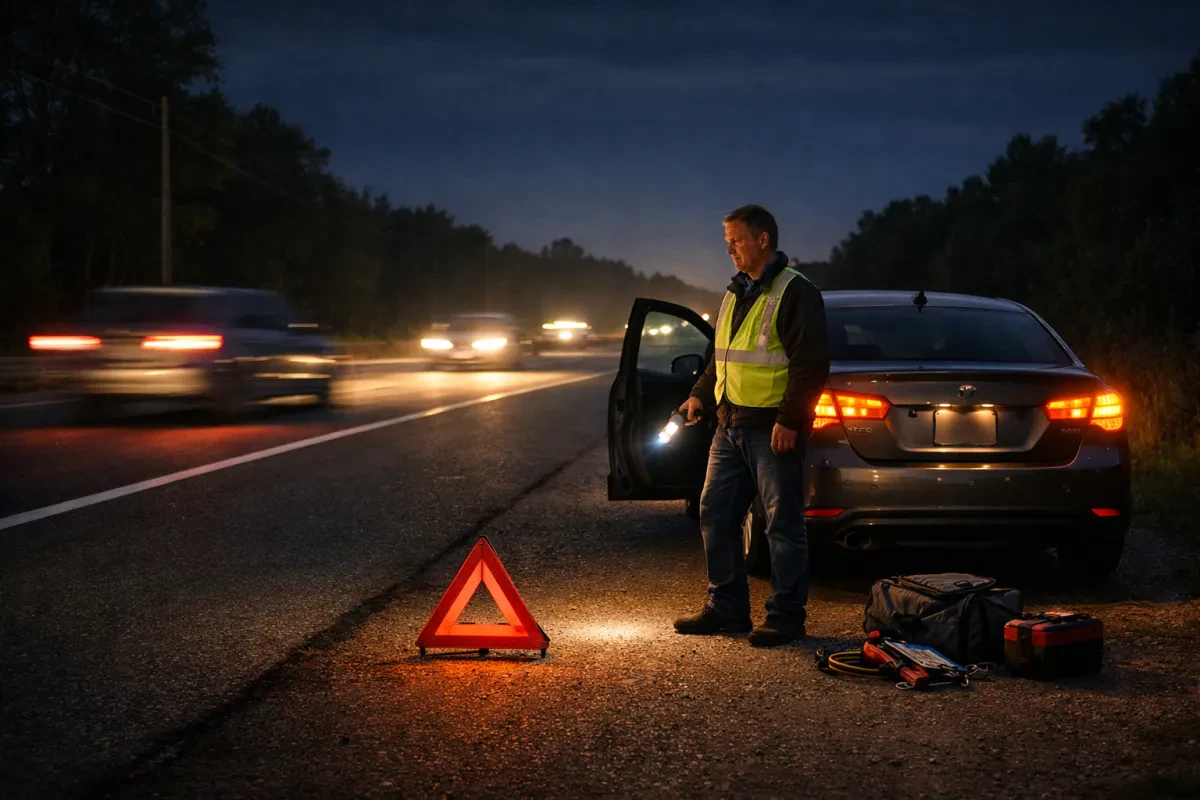
You make yourself visible first. A reflective vest or a simple magnetic hazard triangle placed a short distance behind the car gives approaching drivers more warning than hazard lights alone, especially on roads where people aren’t expecting stopped vehicles at night.
Then you settle back into the car.
This is where carrying the right things changes the entire experience. A phone charger means you don’t start rationing battery. A light jacket or blanket keeps the temperature from becoming a distraction. A small power bank lets you make calls without watching the battery percentage tick down.
You message someone to let them know where you are. Not for rescue — just context. You call roadside assistance and get a rough estimate. Maybe it’s twenty minutes. Maybe it’s longer.
Because you’re prepared, waiting doesn’t feel passive. It feels controlled.
You keep the doors locked, the windows mostly up. You’re aware of footsteps on the footpath, of cars passing occasionally, but you’re not tense. You’re simply present. You can see. You can be seen. You’re comfortable enough to let time pass.
The quiet relief of resolution
When help finally arrives, it doesn’t feel dramatic.
It’s a knock on the window. A friendly face in a high-vis vest. A brief explanation exchanged under the streetlight. The problem might not even be fixed tonight — maybe the car needs towing — but the uncertainty is gone.
As you gather your things, you notice something important: you’re not rattled.
The breakdown didn’t escalate emotionally because you never felt behind the situation. You weren’t scrambling for light, warmth, or battery life. You didn’t feel exposed or rushed. You simply waited, visible and comfortable, until the next step presented itself.
This is what carrying the right items for a nighttime roadside breakdown really does. It doesn’t turn you into a problem-solver or a mechanic. It keeps you steady while the situation resolves itself.
Scenario 2: A Dark Highway Shoulder with Cars Passing at Speed
The sudden loss of power where stopping wasn’t part of the plan
This one happens fast.
You’re travelling at speed, the road ahead lit only by your headlights and the faint red dots of cars far in front of you. There’s no pull-over planned, no turn coming up. Just open road, long stretches between exits, and the quiet hum of tyres on bitumen.
Then something changes.
The accelerator stops responding the way it should. The engine note drops. Warning lights flicker on the dashboard, brighter than usual against the dark. You signal instinctively and guide the car toward the shoulder, heart rate rising just enough to sharpen your focus.
You stop with less ceremony than you’d like — half relief, half tension — knowing immediately that this isn’t a comfortable place to sit for long.
Cars continue past at full speed. The rush of air rocks your car slightly with each one.
The instinct to rush, and the effort to slow yourself down
This kind of breakdown carries a different emotional weight.
It’s not uncertainty so much as urgency. The shoulder feels narrow. The noise feels loud. You become very aware of how close other vehicles are, even when they’re technically a safe distance away.
Your first instinct is to do something — anything — quickly.
Check the engine. Get out. Wave someone down. Call immediately. But rushing is rarely helpful here. What matters is reasserting control over your own pace before the environment does it for you.
You take a breath. You switch on your hazard lights and let them establish a visible rhythm. You check your mirrors and notice that drivers are already giving you space.
This is where what you carry matters more than what you do.
Managing visibility, space, and time while traffic moves around you
The safest move here is often to stay inside the car, seatbelt on, doors locked — but only if you’re visible and comfortable enough to wait.
A high-visibility vest goes on before you open the door, even if you’re only stepping out briefly. If you place a reflective warning triangle, it goes far enough back to give approaching drivers time to react — not right behind the bumper where it’s too late to matter.
Light becomes your anchor.
A torch lets you see without draining your car battery or standing exposed longer than necessary. You don’t linger outside. You do what needs doing and get back in.
Inside the car, the experience shifts again.
You plug your phone into a charger or power bank without hesitation. You don’t conserve battery — you remove that concern entirely. You make the call for assistance, give clear location details, and get a realistic wait time.
Then you settle.
You adjust your seat slightly. You keep your footwell clear. You keep essential items within reach so you don’t have to search for them later. A light blanket or jacket takes the edge off the night air that seeps in through the glass.
Cars continue to pass. The sound fades into the background as something you’re aware of, not something you’re reacting to.
You’re no longer “stuck on the highway.” You’re waiting — deliberately.
The moment the road stops feeling hostile
When the service vehicle arrives, the environment changes immediately.
Flashing lights slow traffic. Space opens up around you. The shoulder feels wider, calmer, less aggressive. What felt urgent twenty minutes ago now feels procedural.
As you step out to speak with the driver, you notice that your body feels steady. Your shoulders aren’t tight. You’re not keyed up or flustered.
The difference wasn’t luck. It was preparation.
You didn’t spend the wait worrying about battery life, visibility, or exposure. You didn’t rush into unsafe movements. You stayed visible, contained, and calm while the situation resolved itself.
That’s the real value of carrying the right things for a nighttime highway breakdown. Not solving the problem — but keeping the problem from expanding beyond what it already is.
Scenario 3: An Isolated Rural Road with No Immediate Help Nearby
When the headlights reveal how alone you really are
This breakdown doesn’t announce itself with traffic or noise.
You’re driving through a stretch of road where the darkness feels deeper. The kind of place where your headlights don’t just light the road — they define it. Beyond them, there’s nothing but blackness. No shopfronts. No footpaths. No glow from nearby houses.
The car begins to struggle. The engine loses strength on a slight incline, then fades entirely. You roll to a stop on the gravel shoulder, tyres crunching softly beneath you.
When you turn the engine off, the silence is immediate.
You sit there for a moment longer than usual, hands still on the wheel, noticing how different this feels from anywhere closer to town.
The weight of distance and time settling in
This is where the emotional wobble feels heavier — not sharper, just slower.
You’re not worried about passing traffic or visibility right away. You’re thinking about distance. How far help might be. How long it could take. Whether your phone signal will hold.
Your mind starts running ahead, filling the quiet with questions you don’t need to answer yet.
You catch yourself and slow things down.
You check your phone. There’s signal — maybe not strong, but enough. You switch on the hazard lights, their steady pulse the only movement in the darkness. You glance around, noting that there’s nowhere else you need to be right now.
This moment isn’t about urgency. It’s about staying grounded when there’s no external reassurance.
Creating a small, controlled space while the night stretches on
Here, what you carry determines how the night unfolds.
A torch lets you step out briefly to check your surroundings without relying on the car’s interior light. You don’t wander. You don’t investigate. You just confirm what you already know — you’re stopped, visible, and not in immediate danger.
You put on a warmer layer. Rural nights cool quickly, and discomfort has a way of magnifying unease. A blanket or jacket isn’t about survival — it’s about staying settled long enough for time to pass without irritation.
You make the call for assistance and get a realistic estimate. It’s longer than the other scenarios. That’s expected.
Inside the car, you organise your space.
You keep your phone charging. You keep essential items close. You turn the interior light off again and let your eyes adjust to the dark. Outside, the hazard lights continue their quiet rhythm, marking your presence without demanding attention.
You don’t scan the darkness constantly. You don’t brace for something to happen. You simply remain aware.
The waiting window here is longer, but it doesn’t have to feel heavier. You might listen to quiet audio. You might sit in silence. Either way, you’re not battling the moment — you’re letting it pass.
The relief of movement returning
When headlights finally appear in the distance, they don’t rush toward you.
They approach slowly, deliberately, until a service vehicle pulls in behind you. The night changes shape immediately. What felt vast and empty now feels defined again.
You step out, stretch your legs, and feel your body loosen without realising it had been tense at all.
The resolution is practical. A tow. A jump-start. A plan for tomorrow. Whatever it is, it’s no longer unknown.
As you gather your things, you notice something subtle: you didn’t endure the wait. You inhabited it.
Because you had light. Because you had warmth. Because you stayed connected and visible. The breakdown never became a story you’d retell with drama — just a quiet inconvenience handled calmly.
This is the difference thoughtful preparedness makes on an isolated road at night. Not control over the situation — but control over how it feels while it unfolds.
What Preparedness Actually Looks Like at Night
A nighttime roadside breakdown doesn’t need to be dramatic to feel unsettling.
Across suburbs, highways, and rural roads, the pattern is the same. Normal movement stops. Time stretches. Your awareness sharpens. What changes isn’t the risk — it’s your relationship with the moment.
Preparedness in these situations isn’t about fixing the car or controlling every outcome. It’s about reducing friction while you wait. Light so you can see without fumbling. Visibility so others can read your presence early. Power so communication stays effortless. Warmth and comfort so your body doesn’t turn waiting into strain.
When those needs are covered, the emotional wobble fades faster. Decisions become easier. Time passes without pressure. You don’t rush, and you don’t spiral.
That’s the difference thoughtful carry items make. They don’t escalate the situation — they soften it.
You’re not trying to prepare for every possible scenario. You’re preparing for the most likely one: standing still at night, waiting for help, wanting to feel steady while the situation resolves itself.
The right things to carry don’t turn your car into a survival vehicle. They simply give you options. And options are what restore calm when routine breaks.
Most breakdowns end quietly. A phone call. A tow. A restart. A drive home that resumes like nothing happened.
When you’re prepared, that’s exactly how it should feel.
Related JICG Guides
- Situational Awareness Habits in Public Spaces (staying calm and observant without spiralling)
- What to Do If You Feel Followed (practical decision-making when you feel uncertain)
One authority reference worth bookmarking: For Australian roadside breakdown safety basics (visibility, staying in the vehicle, and what to do while waiting), see the RACQ guidance here: RACQ.
Frequently Asked Questions
What should I do first if my car breaks down at night?
Start by making yourself visible and staying calm. Turn on your hazard lights, assess where you are, and avoid rushing into action. Once you’re visible and safe, you can focus on communication and waiting for assistance.
Is it safer to stay inside the car during a nighttime breakdown?
In most situations, yes. Staying inside the vehicle with your seatbelt on and doors locked is often safer, especially on busy roads or highways. Only exit the car briefly if you need to improve visibility or move to a safer position.
What items matter most during a roadside breakdown at night?
The most useful items support visibility, communication, and comfort. A torch, reflective gear, phone charger or power bank, and something warm to wear can significantly reduce stress while you wait for help.
How long should I expect to wait for roadside assistance at night?
Wait times vary depending on location and demand, but nighttime assistance can take longer than during the day. Being prepared to wait calmly and comfortably makes a bigger difference than trying to shorten the wait.
Do I need special equipment to be prepared for breakdowns?
No. Preparedness doesn’t require specialised or tactical gear. Simple, everyday items that help you see, be seen, stay connected, and remain comfortable are usually enough.