Solo travel has a different rhythm.
You move on your own schedule. You notice things more clearly. You make decisions without negotiation or noise. For many people, that independence is the point — not something to be managed away.
But travelling alone also changes how responsibility feels. There’s no quiet hand-off of awareness. No shared glance that confirms, “You saw that too.” Every choice — when to move, where to pause, how long to stay — rests with you.
This doesn’t make solo travel dangerous. It makes it deliberate.
Most safety advice aimed at solo travellers either overshoots into fear or collapses into vague reassurance. Neither is particularly useful in real life. What actually helps are habits — small, repeatable behaviours that quietly reduce friction and uncertainty without turning every outing into a threat assessment.
Good solo travel safety isn’t about avoiding people or places. It’s about staying oriented. About noticing when something feels slightly off before it becomes a problem. About having enough awareness, preparation, and self-trust that you don’t second-guess every decision once you’ve made it.
This article isn’t a checklist of “don’ts,” and it isn’t about being on guard all the time. It’s about habits that work in the background — the kind you build once and then rely on without effort.
Through three real-life scenarios, we’ll look at how solo travel safety actually plays out. From the interruption that shifts your attention, through the emotional wobble that follows, into the longer window where habits do their real work. Not dramatic moments — just the everyday situations where being alone changes the texture of the experience.
These are not extreme strategies. They’re practical, human, and quietly effective — whether you’re travelling across town or across borders.
Scenario 1: A Busy Transit Hub Where Everyone Is Moving with Purpose
When the flow around you suddenly feels faster than your own
You’re moving through a place designed for movement.
Train platforms, bus terminals, ferry wharves — they all share the same energy. People walking with intent. Bags rolling behind them. Announcements echoing overhead. It’s busy, but it’s functional, and that usually makes it feel safe.
You’re travelling alone, but you don’t feel isolated. If anything, the crowd provides a kind of cover. You blend in without effort.
Then something small interrupts the rhythm.
You slow to check a departure board. The crowd doesn’t. People stream past on both sides, brushing close enough that you feel it in your shoulders. For a moment, you’re stationary in a moving environment.
Nothing is wrong — but the dynamic has shifted.
The brief internal check that follows
This is where solo travel awareness quietly activates.
You notice that your bag is slightly unzipped. That your phone is still in your hand instead of back in your pocket. That you’re more focused on information overhead than on the people moving around you.
There’s no spike of fear. Just a subtle recalibration.
When you’re alone, there’s no one else to hold your place in the flow while you pause. That means moments of stillness deserve a little more intention.
You close the bag. You step half a metre to the side so you’re no longer directly in the stream of foot traffic. You finish checking the board before moving again.
It’s not defensive. It’s efficient.
Staying oriented without becoming guarded
The rest of the experience unfolds smoothly because of that small adjustment.
You move with the crowd again, not against it. You keep your phone use brief and purposeful instead of drifting into it while walking. When you stop, you stop near fixed points — a wall, a pillar, a bench — places where your position is clear to others.
You don’t scan faces or look over your shoulder repeatedly. You simply remain aware of spacing and movement. You notice who’s lingering without a clear destination and who’s just passing through.
When someone asks for directions, you answer without stepping closer than necessary. When you need to check your route again, you do it from the edge of the space, not the centre.
These habits don’t make you stand out. They make you predictable — and predictability is often what keeps solo travellers from becoming friction points in busy environments.
You’re not trying to avoid interaction. You’re making sure it happens on your terms.
The quiet confidence that comes from staying ahead of small moments
By the time you reach your platform, the earlier interruption barely registers.
You didn’t “handle” a situation. You simply stayed aligned with it. There was no escalation because nothing was allowed to drift unattended.
This is what effective solo travel safety looks like in crowded places. Not heightened alertness, but gentle self-management. Knowing when to pause, where to stand, and how to move so that your attention isn’t split in ways that invite inconvenience or discomfort.
When you’re travelling alone, habits like these don’t add effort — they remove it. They let you move through busy spaces with the same ease as everyone else, without relying on the presence of another person to steady the moment.
The crowd keeps moving. So do you. And the experience remains exactly what it should be — routine, unremarkable, and quietly in your control.
Scenario 2: Arriving Alone at an Unfamiliar Hotel or Rental After Dark
When the surroundings are new and the day has already taken its toll
Arrival is often the quietest part of solo travel — and the most overlooked.
You’ve been in transit all day. Your bag is heavier than it was this morning, even if nothing has changed. The light has softened into evening, and the energy you had earlier has settled into a steady tiredness.
You pull up outside a hotel or rental you’ve never stayed in before. The building looks fine. The street is calm. Nothing about the scene raises concern — but it’s still unfamiliar.
This is the moment where routines tend to slip.
The temptation to switch off too early
When you’re travelling alone, fatigue can blur judgement faster than fear ever could.
You want to get inside. Drop your bag. Sit down. That desire to “be done” nudges you toward shortcuts — skipping a second glance around the entrance, juggling your phone and luggage at the same time, focusing inward instead of outward.
It’s not unsafe. It’s just less deliberate.
The emotional wobble here isn’t anxiety — it’s mental off-duty mode arriving a little too soon.
Creating familiarity through small, repeatable habits
The fix isn’t vigilance. It’s sequencing.
You pause before exiting the vehicle or stepping through the door. You take a quick look down the street, then back toward the entrance. You note lighting, exits, and where other people are positioned — not to assess risk, but to anchor yourself in the space.
Inside, you keep your phone use purposeful. Check-in details come up once, then the screen goes dark again. Your bag stays close to your body rather than resting loosely beside you.
When you reach your room, you don’t rush inside immediately. You listen for a second. You confirm the door closes and locks the way it should. You set your bag down only once you’ve oriented yourself.
These habits take seconds, but they quietly turn a strange place into a known one.
You notice where the light switches are. You locate the nearest exit. You place essentials — phone, wallet, keys — in one consistent spot. By the time you sit down, your environment already feels less abstract.
The moment the space becomes yours
Once those small actions are done, the tension dissolves.
You’re no longer “arriving.” You’ve arrived.
The room settles into the background. The street noise becomes ambient. The door feels like a boundary rather than a barrier.
This is the real work of solo travel safety in unfamiliar accommodation. Not suspicion, but orientation. Turning a new environment into a familiar one as quickly as possible so your body and attention can rest.
When you travel alone, habits like these let you switch off intentionally instead of accidentally. And that’s what keeps the experience calm, grounded, and genuinely restorative.
Scenario 3: Walking Alone at Night in a Place You Don’t Fully Know
When the street quiets and your attention sharpens on its own
This is the moment many solo travellers think about — not because it’s common, but because it’s memorable.
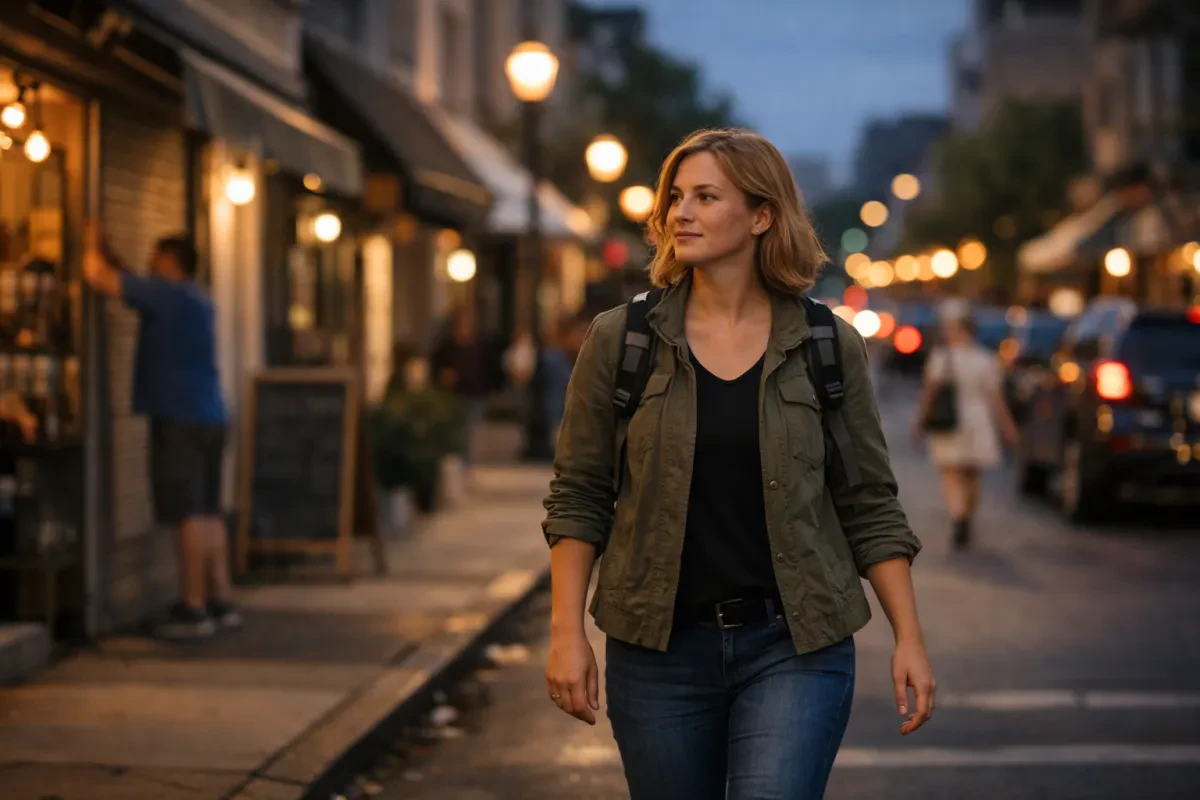
You’ve finished dinner later than planned. The streets are still active, but the edges are softening. Shops are closing. Foot traffic thins out. The pace feels slower, less structured.
You’re walking back toward your accommodation, phone in your pocket, bag slung comfortably. Nothing is wrong. But you’re aware that you’re more noticeable now — not because of who you are, but because there are fewer people around you.
The environment has shifted, and your attention shifts with it.
The subtle internal recalibration that follows
This isn’t fear. It’s awareness rising to meet context.
You notice your surroundings more clearly. The sound of your footsteps. The rhythm of the streetlights. The way side streets open and close as you pass them.
Your mind checks in quietly: Am I moving with purpose? Do I know where I’m going?
You adjust without stopping.
Your pace becomes steady and intentional. Not rushed, not hesitant. You keep your phone put away so your attention stays outward. When you glance at directions, you do it briefly and then continue moving.
You’re not trying to disappear. You’re simply signalling that you belong exactly where you are.
Using movement and awareness to stay settled
As you walk, you choose paths that feel open rather than enclosed. You favour well-lit streets over shortcuts. When you pass other people, you acknowledge them without inviting interaction — a nod, neutral eye contact, then onward.
You don’t rehearse responses or imagine outcomes. You stay present.
If something feels slightly off — a street that’s quieter than expected, a group lingering without clear purpose — you don’t freeze or second-guess yourself. You adjust early. You cross the street. You alter your route. Small changes made early rarely draw attention.
This is where solo travel habits show their value.
You’re not reacting to danger. You’re maintaining options.
Because you’ve stayed oriented the entire time, the walk doesn’t accumulate tension. Each decision resolves itself quickly instead of stacking on top of the last.
The calm arrival that tells you it worked
When you reach your destination, the shift is immediate.
You step inside. The door closes behind you. The street noise fades. Your shoulders drop without you consciously releasing them.
You realise that the walk didn’t require courage or confrontation — just presence.
This is the difference between habits that actually work and advice that sounds good on paper. Effective solo travel safety doesn’t ask you to be braver or more alert than necessary. It asks you to stay connected to your environment long enough to move through it smoothly.
When you travel alone, moments like this become confirmation rather than concern. You didn’t avoid something. You navigated it.
And you arrive not relieved, but settled — exactly as you should.
Why These Habits Matter More Than Advice
Solo travel doesn’t become safer because you memorise rules.
It becomes easier because you build habits that work quietly in the background — habits that don’t demand constant attention or emotional energy.
Across busy transit hubs, unfamiliar accommodation, and quiet streets at night, the common thread is the same. You notice small shifts early. You stay oriented instead of reactive. You make minor adjustments before anything has a chance to feel complicated.
None of this requires heightened alertness or a guarded mindset. In fact, the opposite is true. When habits are simple and repeatable, they free your attention rather than consume it.
Good solo travel safety isn’t about avoiding experiences. It’s about staying present inside them. Knowing where you are. Moving with purpose. Letting awareness rise and fall naturally with the environment instead of forcing it.
When these habits are in place, being alone doesn’t feel like a vulnerability. It feels like clarity.
You stop second-guessing small decisions. You trust your ability to navigate unfamiliar spaces without turning every moment into a test. And when a situation resolves — as most do — it does so quietly, without leaving a mark.
That’s what habits that actually work give you.
Not protection from the world, but confidence moving through it — on your own terms.
Frequently Asked Questions
Is solo travel actually safe?
For most people, yes. Solo travel safety is less about avoiding places and more about building habits that help you stay oriented, deliberate, and aware as situations change.
Do I need to be constantly alert when travelling alone?
No. Effective solo travel safety habits work in the background. They reduce friction and uncertainty without requiring constant vigilance or anxiety.
What are the most important solo travel safety habits?
The most helpful habits include moving with purpose, limiting distractions, staying aware of your surroundings, and making small adjustments early when something feels slightly off.
Is it better to avoid going out alone at night?
Not necessarily. Many people travel safely alone at night by choosing well-lit routes, avoiding unnecessary shortcuts, and staying present rather than distracted.
How can I feel more confident travelling alone?
Confidence grows from familiarity and consistency. When your habits are steady and repeatable, unfamiliar environments feel easier to navigate without second-guessing yourself.